

Plaster in Crafts: Creative Ideas, Techniques, and Tips for DIY Decorations
TL;DR:
Plaster in crafts is not just a material for school projects: it can become the base for decorations, party favors, trays, candle holders, and handmade home decor objects.
To achieve a polished result, it is important to choose the right material, respect the correct proportions, and use suitable molds, pigments, and finishes.
With Aqua Resin, a premium mineral plaster that is water-based, non-toxic, and easy to work with, you can create elegant-looking objects even if you are just starting out.
Plaster is one of those materials that many people still associate with school projects or construction sites. In reality, in the world of creative crafts, it can become a surprising base for making decorations, party favors, trays, candle holders, frames, and small objects for the home.
Today, alongside traditional plasters, there are more practical and refined DIY materials, such as Aqua Resin: a premium mineral plaster, water-based, non-toxic, and easy to work with, designed for those who want to obtain smooth surfaces, defined details, and an elegant result even at home.
In this guide, we will see how to choose the right material, how to prepare it, how to color it, and which projects to create to transform a simple powder into something beautiful, personal, and made with your own hands.
Table of Contents
-
What creative plaster is and why use it in crafts
-
Types of plaster for crafts: which one to choose
-
How to prepare creative plaster: proportions and useful tools
-
How to color plaster with pigments, glitter, and finishes
-
Creative ideas with plaster: party favors, trays, candle holders, and home decor
-
How to make creations more resistant with Aqua Shield
-
Common mistakes to avoid when working with plaster
-
Recommended products to start with Aqua Resin
-
Frequently asked questions about plaster in crafts
Key Points
- Choice of material: traditional plaster is useful for many projects, but a premium plaster like Aqua Resin offers greater simplicity, safety, and aesthetic results.
- Correct preparation: each material has specific proportions. With Aqua Resin, use 100 g of powder and 30 g of cold water.
- Effective coloring: powder pigments, glitter, and finishes allow you to personalize every creation.
- Creative finishes: with sanding, protection, and final decorations, you can obtain more refined and durable objects.
- Room for creativity: molds, colors, and different textures allow you to create personalized party favors, trays, candle holders, and home decor.
Types of plaster for crafts: which one to choose and why
Before starting a creative project, it is important to understand which material to use. Not all plasters perform in the same way: some are more suitable for small decorative works, others for more resistant objects or more refined finishes.
In DIY, you can find traditional plasters, such as Plaster of Paris or alabaster plaster, more technical plasters, and premium formulations designed for creative crafts, such as Aqua Resin.
Plaster of Paris and alabaster plaster are among the most common solutions for small decorative projects. They are easy to find, simple to work with, and suitable for molds, frames, and lightweight decorations. However, they can be more fragile or porous if they are not properly finished and protected.
Aqua Resin was created precisely for those looking for a more refined solution for crafts: it is a premium mineral plaster, water-based, non-toxic, and easy to use, ideal for creating decorative objects with smooth surfaces, defined details, and an elegant effect.
Synthetic plaster, on the other hand, is more compact and resistant. It is used when the project requires dimensional precision, sharp edges, or greater final hardness. It is perfect for objects that need to withstand daily wear, such as trays, storage dishes, or sculptural bases.

Here is a direct comparison of the main types:
| Type of plaster | Consistency | Ease of use | Resistance | Ideal for |
|---|---|---|---|---|
| Plaster of Paris | Fine and lightweight | High | Medium | Decorations, molds, frames |
| Alabaster plaster | Very fine | High | Medium | Detailed artistic work |
| Synthetic plaster | Compact | Medium | High | Functional objects, precision |
| Aqua Resin | Fine mineral powder | Very high | High, can be improved with Aqua Shield | Party favors, trays, candle holders, home decor, decorative objects |
Some important things to know before buying:
-
Loose powder: maximum flexibility, total control over proportions and coloring
-
Preformed molds: ideal for those who want immediate results without previous experience
-
Plaster with additives: some formulations already include integrated reinforcements or waterproofing agents
The presentation format you choose depends greatly on the type of project. For most craft projects, loose powder remains the most versatile and economical choice.
How to prepare creative plaster: proportions, tools, and practical tips
Once you have chosen the right type of plaster, let’s see how to prepare it properly step by step.
Preparation is the most delicate moment. A mistake in the proportions or mixing technique can compromise the entire pour. The good news is that with a few clear rules, the process becomes quick and almost automatic.
Here is what you need to get started:
-
Powdered plaster (Plaster of Paris or alabaster plaster for beginners)
-
Cold water, if you are working with Aqua Resin. For other plasters, always follow the manufacturer’s instructions.
-
Clean and dry bowl (preferably plastic or silicone, easy to clean)
-
Spatula or spoon for mixing
-
Kitchen scale for accurate measuring
-
Silicone molds to shape the plaster
The proportions change depending on the material used. With traditional plasters, it is always best to follow the instructions on the packaging.
If you are working with Aqua Resin, the recommended proportion is 100 g of powder + 30 g of cold water. This mixture allows you to obtain a fluid compound, easy to pour into molds and suitable for creating decorative objects with good detail definition. This ratio ensures a fluid but not overly liquid consistency, perfect for filling molds without leaving bubbles.
For a more uniform mixture, pour the water into the container first and gradually add the powder. Mix calmly until you obtain a smooth, lump-free compound. Adding the powder slowly helps reduce air bubbles and imperfections on the final surface.
Silicone molds are among the best allies for those working with creative plaster at home. They are flexible, do not require release agents, and allow you to unmold the pieces without damage. You can use the drop tray mold for soft organic shapes, the round tray mold for classic and elegant projects, or the modern asymmetrical mold for a contemporary and original touch.
Pro Tip: After pouring the plaster into the mold, gently tap the bottom of the container on the table for about ten seconds. This movement brings air bubbles to the surface, ensuring a more even pour without imperfections.
If you use Aqua Resin, let the creation harden in the mold for about 30 minutes. For finishing touches, such as sanding, decorating, or final protection, it is best to wait until the piece is completely dry.
If you want to create special shapes, you can start with ready-made silicone molds or consider specific materials for making custom molds.
How to color creative plaster with pigments, glitter, and finishes
Once your plaster is prepared, you can discover how to personalize each piece through coloring: here is how.
Coloring plaster is one of the most satisfying steps of the entire process. Seeing a white mixture transform into an object with warm, cool, or metallic tones is a small magic every time. There are two main techniques, each with its own advantages.
| Technique | When to use it | Main advantage | Pay attention to |
|---|---|---|---|
| Dry coloring | Before adding water | Uniform and deep color | Precise dosage required |
| Coloring in the mixture | After mixing plaster and water | More flexible, correctable | Risk of streaks if not mixed well |
| Painting after drying | On the finished and dry object | Maximum decorative precision | Requires primer or sealant |
The dry technique is the one that guarantees the most uniform results. You can mix the pigment directly into the powder before adding water, starting with small quantities and gradually increasing until you reach the desired shade.
To obtain a more uniform color, you can mix the pigment directly into the powder before adding water. Always start with small quantities and gradually increase until you reach the desired shade.
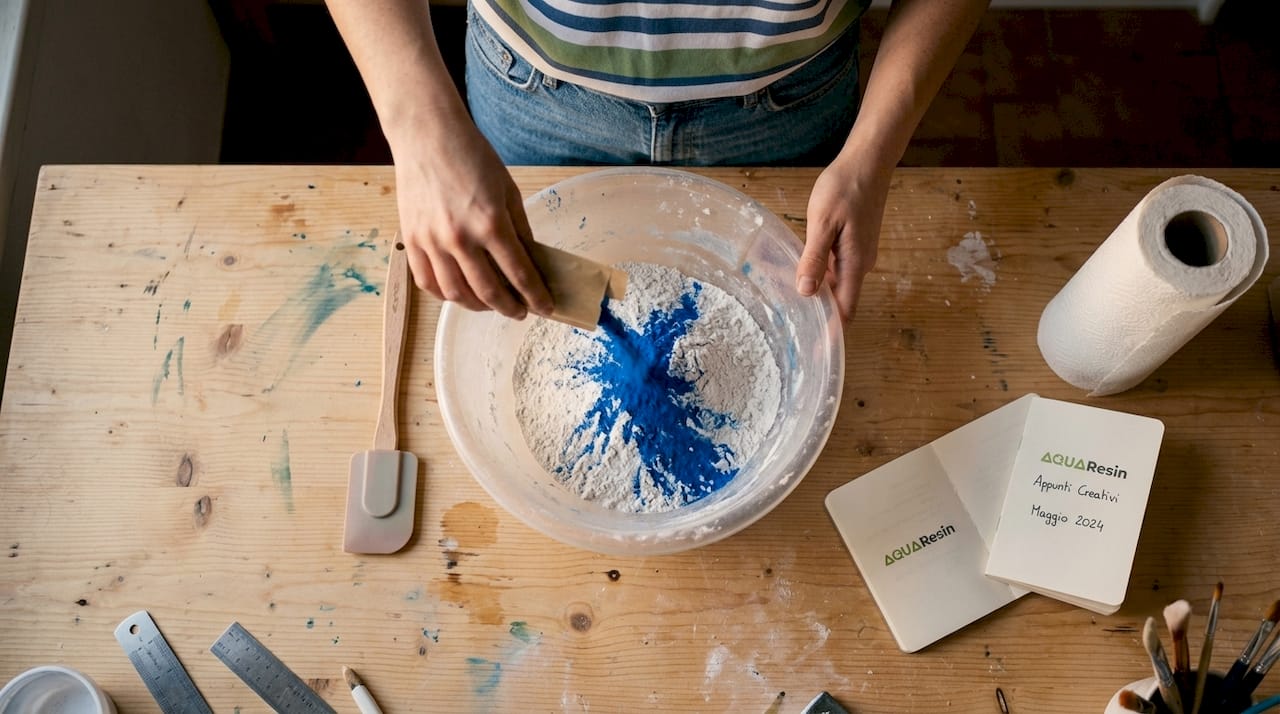
Coloring in the mixture, on the other hand, is more suitable for those who want to experiment with shades or correct the color during processing. Add the pigment after mixing plaster and water, and continue working until you obtain the desired shade.
Some practical guidelines for choosing colorants:
-
Concentrated powder pigments: the most precise and versatile, easy to dose
-
Liquid acrylic colors: excellent for those used to painting, they blend well into the mixture
-
Pearlescent or metallic pigments: they create luminous and refined effects, perfect for party favors and gift objects
-
Glitter: to be added dry or on the surface for sparkling effects
With Aqua Resin, you can personalize your creations using powder pigments, glitter, gold leaf, silver leaf, or metallic finishes. If you want a more homogeneous and intense result, you can mix the pigment directly into the powder before adding water.
Pro Tip: Always test the color on a small sample before proceeding with the full project. Remember that many mixtures tend to lighten slightly after drying. For this reason, it is always useful to make a small test before coloring the entire project. Keep this in mind when dosing pigments.
A common mistake is adding too much pigment in the hope of obtaining a more intense color. It is better to proceed with small doses and make a test, so you maintain good workability of the mixture and a more controlled result.
Creative ideas with plaster: party favors, trays, candle holders, and home decor
Coloring adds personality to your project, but it is the applications and finishes that give it a truly personal final touch. Plaster lends itself to a variety of applications that go far beyond what you might imagine.
Here are some simple ideas to create:
- DIY party favors: hearts, flowers, small trays, decorative tags, or favor holders.
- Trays and catchall dishes: perfect for jewelry, keys, candles, or small desk objects.
- Candle holders: to be protected with Aqua Shield to increase resistance and protection from wax.
- Home decor: coasters, mini vases, decorative frames, and porcelain-effect objects.
- Personalized gifts: small colorful creations decorated with glitter, pigments, or gold leaf.
- Seasonal decorations: hearts, stars, leaves, flowers, and small decorative elements for special occasions.
For a more refined finish, you can lightly sand the surface, decorate with suitable pigments or colors, and protect the creation with Aqua Shield, useful for making the object more resistant, luminous, and protected from humidity.
For finishing, the most important step is sanding. Once dry (at least 24 hours in a dry environment), the piece can be sanded with fine sandpaper to remove imperfections and obtain a surface as smooth as ceramic. Then it is sealed with a transparent protective coating to preserve the color and protect it from humidity.
“Plaster is not just an inexpensive material: it is a blank canvas that responds to every creative gesture, from the simplest to the most refined.”
If you want to explore warm and natural shades, Aqua Resin Terracotta Roma is an ideal choice for Mediterranean, rustic, or contemporary-style objects.
How to make creations more resistant with Aqua Shield
Some decorative objects need extra protection, especially if they are used often or if they may come into contact with humidity, wax, or small water residues. This is the case for candle holders, trays, catchall dishes, coasters, and small decorative vases.
In these cases, you can use Aqua Shield, the additive designed to make Aqua Resin creations more resistant, compact, and protected. It can be used directly in the mixture instead of water, following the proportion 100 g of Aqua Resin + 50 g of Aqua Shield.
The result is a brighter, smoother, and more pleasant-to-touch surface, with an effect similar to porcelain. This is why it is especially suitable when you want to obtain more elegant decorative objects or pieces designed to last over time.
Want a more resistant and luminous result?
Discover Aqua Shield and pair it with your Aqua Resin creations.
Common mistakes to avoid when working with creative plaster
We have explored ideas and techniques, but there is much more behind the art and creative practice of working with plaster.
Creative plaster seems like a simple material, but precisely for this reason it is often underestimated. The difference between an amateur result and a refined creation does not depend only on the pour, but on three details: correct proportions, choice of mold, and final finish.
Air bubbles, irregular edges, or small imperfections can happen, especially at the beginning. To avoid them, mix calmly, pour the compound slowly, and tap the mold on the table after pouring.
Another common mistake is neglecting the final protection. An unprotected object can absorb humidity or stain more easily. That is why, when making trays, candle holders, or decorative objects to be used often, you should always consider a protective finish such as Aqua Shield.
The resistance of plaster depends enormously on how it is treated after pouring. An unsealed object exposed to humidity deteriorates quickly. A carefully sealed one, on the other hand, can last for years. This is an aspect that many tutorials do not emphasize enough: the finish is not optional, it is an integral part of the project.
There is also a stylistic aspect worth discussing. Many hobbyists tend to follow current trends, replicating shapes and colors they see on social media. There is nothing wrong with that, but plaster rewards those who find their own voice. Combining it with recycled materials, natural fibers, raw wood, or broken ceramics creates unique objects that tell a story. That story is you.
With practice, even basic recipes become personal. You learn to recognize the right consistency of the mixture by eye, you already know how much pigment to add to obtain your favorite shade, and you know the drying times of your own space. This is the real leap in quality, and the round tray mold you use on your third project will give you completely different results compared to your first attempt.
Recommended products to start with Aqua Resin
If you want to start working with creative plaster using a simple, safe material suitable even for complete beginners, you can start with Aqua Resin.
White Aqua Resin is ideal for creating elegant and luminous decorative objects: party favors, catchall dishes, trays, coasters, and small home decor accessories.
Aqua Resin Terracotta Roma is perfect if you love warm, natural, and Mediterranean shades. It is already pigmented in terracotta color and allows you to obtain fired-clay-effect creations without having to manually color the mixture.
Aqua Shield is recommended when you want to make creations more resistant, compact, and protected, especially for candle holders, decorative vases, and objects intended for frequent use.
To personalize your projects, you can combine pigments, glitter, gold leaf, silver leaf, and silicone molds, choosing shapes and finishes according to the style you want to achieve.
You can start with natural terracotta-colored plaster, a premium non-toxic and safe formulation, perfect for decorative objects with a warm and contemporary aesthetic. To personalize your pieces, you will also find a range of pigments for plaster in different shades, from natural tones to pearlescent metallics. And to give shape to your ideas, the collection of handcrafted silicone molds offers original, handmade shapes that transform every pour into a small masterpiece. With Aqua Resin, you have everything you need to start today, even if it is your first time.
Plaster in crafts is a simple, versatile, and surprising material. With the right proportions, a suitable mold, and a few creative details, you can transform a small idea into a handmade object that is personal and beautiful to display.
If you want to start with an easy-to-use, safe material designed for creative DIY, discover Aqua Resin and get inspired by pigments, glitter, molds, and finishes to give shape to your next project.
Frequently asked questions about using plaster in crafts
What is the difference between Plaster of Paris and synthetic plaster?
Plaster of Paris is a traditional solution, fine and easy to work with, suitable for lightweight decorations and small molds. Synthetic plaster is generally more compact and resistant. Aqua Resin, on the other hand, is a premium mineral plaster designed for creative crafts: it is worked with water, is non-toxic, easy to use, and suitable for refined decorative creations.
What is the recommended water/plaster ratio to obtain a good result?
It depends on the material used. With Aqua Resin, the recommended proportion is 100 g of powder + 30 g of cold water. If instead you want to use Aqua Shield in place of water, the recommended proportion is 100 g of Aqua Resin + 50 g of Aqua Shield. For other types of plaster, always follow the manufacturer’s instructions.
How do you color plaster without risking stains or streaks?
To obtain a uniform color, you can mix the pigments directly into the powder before adding water. Alternatively, you can add them to the already prepared mixture, mixing carefully. The advice is to always make a small test, because the color may change slightly after drying.
How do you protect plaster creations from humidity?
You can protect creations with Aqua Shield. With Aqua Resin, you can use it directly in the mixture instead of water, or apply it to the dry creation as a protective finish. It is especially useful for objects such as candle holders, trays, coasters, and small decorative vases.
Which accessories can I use to easily personalize plaster?
You can personalize creations with silicone molds, powder pigments, glitter, gold leaf, silver leaf, acrylic colors, and small decorations. With Aqua Resin, you can obtain different effects depending on the combination of color, mold, and finish chosen.
Useful products and resources
-
White Carrara Aqua Resin: premium mineral plaster, non-toxic and easy to use
-
Aqua Resin Terracotta Roma: premium plaster already pigmented in a terracotta shade
-
Aqua Shield: additive/protective coating for more resistant and luminous creations
- Aqua Pigment: pigments to color your creations
- Aqua Glitter: glitter for bright and decorative effects
- Aqua Resin silicone molds: shapes for trays, candle holders, catchall dishes, and home decor
-
Creative ideas, tutorials, and inspiration with Aqua Resin – Official Blog
Share:
0 comments
Products recommended in this article


Your first project? Start here and save 10%!
Download the free eBook with step-by-step tutorials and original ideas to get started. All you need is your email address!