

Difference Between Plaster and Resin: Which One to Choose for Creative DIY
TL;DR:
Traditional plaster and epoxy resin are different materials: the first is simple, affordable and suitable for indoor decorations; the second allows glossy, transparent and more technical effects, but requires greater care during processing.
Aqua Resin is not an epoxy resin: it is a premium alpha plaster, 100% natural, VOC-free and safe for home use, designed for creative projects such as favors, trays, candle holders and home decor.
If you are looking for simplicity, a smooth porcelain-effect finish, high scratch and impact resistance and creations ready in about 30 minutes, Aqua Resin is the most suitable choice for creative DIY.
Have you ever started a creative project by choosing the material “by eye” and then discovered that the result was not what you imagined? It often happens when traditional plaster, epoxy resin and new premium materials for DIY are confused.
Traditional plaster is simple and affordable, but it can be more porous and fragile. Epoxy resin allows glossy and transparent effects, but requires more care during processing. Aqua Resin, on the other hand, is a premium alpha plaster: it mixes with water, is 100% natural, VOC-free and safe for home use. Thanks to its ultrafine grain, it allows you to create favors, trays, candle holders and home decor objects with a smooth porcelain-effect finish.
In this guide, we look at the differences between traditional plaster, epoxy resin and Aqua Resin, so you can choose the most suitable material for your creative project.
Index
-
What traditional plaster is and how it is used in DIY
-
Epoxy resin and Aqua Resin: two materials not to be confused
-
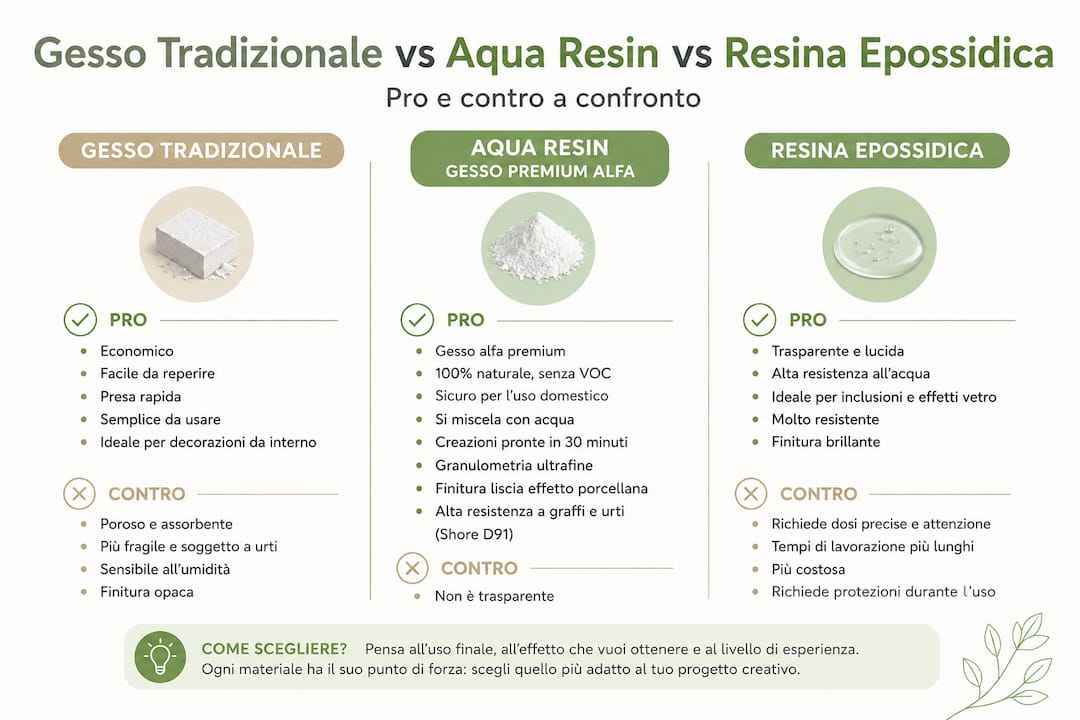
Traditional plaster, Aqua Resin and epoxy resin compared
-
When to choose plaster, Aqua Resin or epoxy resin
-
Common mistakes when choosing the material
-
Recommended products to get started with Aqua Resin
-
Frequently asked questions
Key Points
| Point | Details |
|---|---|
| Traditional plaster | Affordable, simple and suitable for indoor decorations, but more porous and fragile if not protected. |
| Epoxy resin | Ideal for transparent, glossy effects and inclusions, but more technical to mix and work with. |
| Aqua Resin | Premium alpha plaster, 100% natural, VOC-free, with ultrafine grain and a smooth porcelain-effect finish. |
| Resistance and finish | Aqua Resin offers high scratch and impact resistance, with Shore D91 hardness, and creations ready in about 30 minutes. |
| Material choice | There is no best material in absolute terms: there is the one best suited to the project, the aesthetic result and the final use. |
What traditional plaster is and how it is used in DIY
Traditional plaster is one of the best-known materials in the world of hobby crafting and decoration. It comes in powder form, mixes with water and hardens quickly, making it possible to create small objects, decorations, frames, ornamental elements and indoor creative projects.
It is a simple and affordable solution, very suitable for creative tests, school activities, light decorations and projects where the final result does not need to be exposed to moisture or frequent use. Its main limitation is porosity: if it is not protected, it can absorb water, stain or chip more easily.
Traditional plaster is therefore useful when you are looking for an immediate material that is easy to find and quick to work with. To obtain a more durable result, however, it is important to finish and protect the surface, especially if the object will be handled often or placed in humid environments.
Its main characteristics are:
-
Simple processing: it mixes with water and pours easily into molds.
-
Fast setting time: it allows you to create decorations in a short time.
-
Matte and porous surface: it can absorb colors, paints and finishes.
-
Affordable cost: it is suitable for tests, exercises and small projects.
-
Variable fragility: it can chip or break if not finished correctly.
-
Sensitivity to moisture: it requires protection if exposed to water, steam or humid environments.
Plaster is commonly used to make figurines, wall decorations, frames, small ornamental vases and gift objects. If you are looking for inspiration for this type of work, you can also explore the Aqua Resin guide dedicated to plaster in hobby crafting.
Traditional plaster works well when the project remains decorative, indoors and protected. The best result always comes from choosing the right material for the final use.
Pro Tip: if you work with traditional plaster, always protect the surface with a suitable finish. If instead you want to obtain a smoother, more compact effect close to porcelain, consider Aqua Resin as a premium alpha plaster for creative DIY.
Epoxy resin and Aqua Resin: two materials not to be confused
When people talk about “resin” in DIY, they often think of epoxy resin: a two-component, glossy and transparent material used for jewelry, inclusions, glass-effect tables, decorations with dried flowers and very shiny surfaces.
Aqua Resin is different: it is not a transparent epoxy resin. It is a premium alpha plaster, 100% natural, VOC-free and safe for home use. It simply mixes with water and allows you to obtain creations ready in about 30 minutes, with a smooth, compact surface and an elegant porcelain effect.
Epoxy resin is more suitable when you want transparent effects, crystal-clear inclusions or very glossy surfaces. Aqua Resin is more suitable when you want to create favors, trays, candle holders, catchall trays and home decor with simple processing, a refined finish and a premium aesthetic result.
Thanks to its ultrafine grain and resistance to scratches and impacts, Aqua Resin is ideal for those looking for an easy-to-use material capable of delivering a solid, elegant result that is pleasant to the touch.
Traditional plaster, Aqua Resin and epoxy resin compared
After distinguishing traditional plaster, Aqua Resin and epoxy resin, it is useful to compare them side by side to understand which material to choose depending on the project.
| Feature | Traditional plaster | Aqua Resin | Epoxy resin |
|---|---|---|---|
| Type of material | Traditional mineral powder | Premium alpha plaster | Two-component resin |
| Preparation | Mixes with water | Mixes with water | Mixes with hardener |
| Final effect | Matte and porous | Smooth, compact, porcelain effect | Glossy and transparent |
| Ease of use | High | High | Medium, requires more care |
| Working time | Variable depending on the plaster | Creations ready in about 30 minutes | Variable, often longer |
| Personalization | Matte colors and paint | Pigments, glitter, Aqua Metal, gold/silver leaf | Pigments, glitter, inclusions |
| Resistance | Variable, often more fragile | High scratch and impact resistance, Shore D91 | High, depending on the type of resin |
| Safety of use | Depends on the product | 100% natural, VOC-free, safe for home use | Requires greater care and protective equipment |
| Ideal for | Tests, simple decorations, school projects | Favors, trays, candle holders, catchall trays, home decor | Jewelry, inclusions, glass effects |
| Attention | Can be porous | Follow the indicated proportions | Follow doses, times and protections |
As you can see, each material has a different role. Traditional plaster is useful for simple and decorative projects. Epoxy resin is suitable when you are looking for transparency, inclusions or very glossy surfaces. Aqua Resin stands as a premium solution for creative DIY: it is as easy to use as plaster, but offers a smoother, more elegant and more resistant finish, with a porcelain effect.
The key criteria to consider before choosing:
-
Where will the finished object live? Dry indoor space, bathroom, kitchen or a more exposed area?
-
Will it be exposed to moisture, wax or frequent use?
-
Do you need a glossy, matte, transparent or porcelain-effect finish?
-
Do you want simple processing or are you willing to manage a more technical material?
-
How much time do you have to make and finish the project?
Evaluating the final use of the object is the simplest way to avoid mistakes: a material that is perfect for an indoor decoration may not be suitable for an object exposed to moisture or handled every day.
When to choose plaster, Aqua Resin or epoxy resin: practical examples
After looking at the differences between the materials, let’s look at some concrete cases. The choice always depends on three factors: where the object will be used, how much it will be handled and what aesthetic effect you want to achieve.
-
Wall decorations or indoor objects
If the object will remain in a dry environment, traditional plaster can work well for tests, light decorations and simple projects. If you want a smoother and more refined effect, Aqua Resin is more suitable. -
Trays, catchall trays and candle holders
Aqua Resin is an ideal solution for decorative objects to use at home. Its ultrafine grain makes it possible to obtain smooth surfaces and defined details, while its high scratch and impact resistance makes it suitable for refined and durable creations. -
Favors and personalized gifts
For favors, small gift objects and event decorations, Aqua Resin allows you to obtain an elegant, customizable result that is also suitable for beginners. It mixes with water, is safe for home use and allows creations to be demolded in about 30 minutes. -
Transparent effects, inclusions or jewelry
If you want to embed dried flowers, create glass effects or make transparent jewelry, epoxy resin is the most suitable material. Aqua Resin, on the other hand, is designed for a white, compact, material finish with a porcelain effect. -
Creative tests and educational activities
Traditional plaster can be useful for exercises, tests or simple activities. If instead you want to turn the project into a more refined object, you can switch to Aqua Resin.
Pro Tip: before starting an important project, always think about the final environment of the object. Do you need a matte, glossy, transparent or porcelain-effect finish? Do you want an easy-to-use material or a more technical one? These questions help you choose better.
Here is a practical summary:
| Scenario | Recommended material | Why |
|---|---|---|
| Simple indoor decorations | Traditional plaster | Affordable and easy for creative tests |
| Favors and handmade gifts | Aqua Resin | Porcelain effect, smooth surface and easy personalization |
| Trays, catchall trays and candle holders | Aqua Resin | High scratch and impact resistance, compact and refined finish |
| Transparent jewelry or inclusions | Epoxy resin | Allows glass effects and embedding of elements |
| Porcelain-effect home decor | Aqua Resin | Premium alpha plaster, safe, easy and beautiful |
Common mistakes when choosing between plaster, Aqua Resin and resin
The first mistake is thinking that all plasters are the same. Traditional plaster can be useful for tests and simple decorations, but if you want to obtain a smoother, more compact and more resistant surface, a premium solution such as Aqua Resin can make the difference.
The second mistake is thinking that epoxy resin is always the best choice. It is not: if you do not need transparency, inclusions or glass effects, it can be more technical than necessary. For favors, trays, candle holders and home decor, Aqua Resin can be a simpler, safer and more immediate choice.
The third mistake is not doing tests. Even when the material is easy to use, each mold, pigment and finish can slightly change the final result. A small sample helps you evaluate color, consistency, times and aesthetic result.
The right material is not the best in absolute terms, but the one most suited to the project you want to create.
Pro Tip: before starting a larger production, always make a sample. It will help you understand proportions, demolding times, pigment performance and the most suitable finish.
Recommended products to get started with Aqua Resin
Now that you know the difference between traditional plaster, Aqua Resin and epoxy resin, you can choose the material best suited to your project.
If you want to create favors, trays, catchall trays, candle holders and home decor objects with simple processing and an elegant effect, you can start with white Aqua Resin: the premium alpha plaster, 100% natural, VOC-free, safe for home use and characterized by an ultrafine grain that gives a smooth porcelain-effect finish.
For a warm and natural style, you can choose Aqua Resin Terracotta Roma; for a more contemporary effect, you can use Aqua Resin Black. Complete the project with silicone molds, pigments, Aqua Metal, glitter, gold leaf and silver leaf to personalize every detail.
Aqua Resin was created to make DIY simpler, safer and more beautiful: it mixes with water, allows creations to be demolded in about 30 minutes and offers high scratch and impact resistance, with Shore D91 hardness.
Frequently asked questions
What is the main difference between plaster and resin?
Traditional plaster is a mineral powder that mixes with water and gives a matte and porous result. Epoxy resin is a two-component material, often used for transparent, glossy effects and inclusions. Aqua Resin is different from both: it is a premium alpha plaster, 100% natural, VOC-free and designed for decorative DIY projects with a smooth porcelain-effect finish.
Is Aqua Resin an epoxy resin?
No. Aqua Resin is not a transparent epoxy resin. It is a premium alpha plaster that mixes with water and makes it possible to obtain compact, smooth creations with a porcelain effect.
Is Aqua Resin resistant?
Yes. Aqua Resin offers high scratch and impact resistance, with Shore D91 hardness. It is suitable for favors, trays, candle holders, catchall trays and home decor objects.
When is it better to use epoxy resin?
Epoxy resin is more suitable when you want transparent effects, inclusions, glass-like surfaces or jewelry with embedded elements.
Which material should I choose for favors and home decor?
For favors, trays, candle holders and decorative objects for the home, Aqua Resin is a practical solution because it combines ease of use, a smooth porcelain-effect finish, safety for home use and the possibility of personalization with pigments, glitter and finishes.
Useful products and resources
-
Guide to plaster in hobby crafting: creative ideas, techniques and tips to get started.
-
White Aqua Resin: premium alpha plaster, extra white, 100% natural, VOC-free, safe and easy to use.
-
Aqua Resin Terracotta Roma: premium alpha plaster already pigmented in a terracotta shade.
-
Aqua Resin Black: black premium alpha plaster for elegant and contemporary creations.
-
Aqua Pigment, Aqua Glitter and Aqua Metal: colors, glitter and finishes to personalize every creation.
Share:
2 comments
-
Bonjour et merci pour votre question !
Oui, pas de problème. Une fois sèche, la résine Aqua Resin est un gesso alpha : c’est une base idéale pour la peinture. Les peintures acryliques adhèrent parfaitement, et la cire colorée appliquée à froid offre un magnifique fini satiné qui met en valeur la texture.
Quelques conseils :
— Attendez que la pièce soit complètement sèche avant de peindre. Elle peut être démoulée après 30 minutes, mais le séchage complet prend 24 heures.
— Le gesso étant absorbant, la première couche absorbera une partie de la cire. Appliquez une fine couche de fond, puis peignez.
— Pour un fini métallique, nous proposons Aqua Metal, spécialement formulé pour la résine Aqua Resin et à appliquer au pinceau sur la pièce sèche.
— Si votre objet a été réalisé avec Aqua Shield, qui est imperméable, la peinture risque de ne pas adhérer.
Bonne création ! 😊
Team Aqua Resin on
-
Bonjour, est ce que l’objet fini et sec peut être ensuite peint avec de la peinture acrylique par exemple ou de la cire coloré etc ? Merci
MAECHLER on
Products recommended in this article


Your first project? Start here and save 10%!
Download the free eBook with step-by-step tutorials and original ideas to get started. All you need is your email address!